San Antonio · Texas
Why Does Softened Water Still Feel Slippery or Leave a Film on Dishes?
★★★★★ 5-Star Rated · Trusted in Bexar County
BBB Torch Award 2020
Licensed & Insured
In-House Team
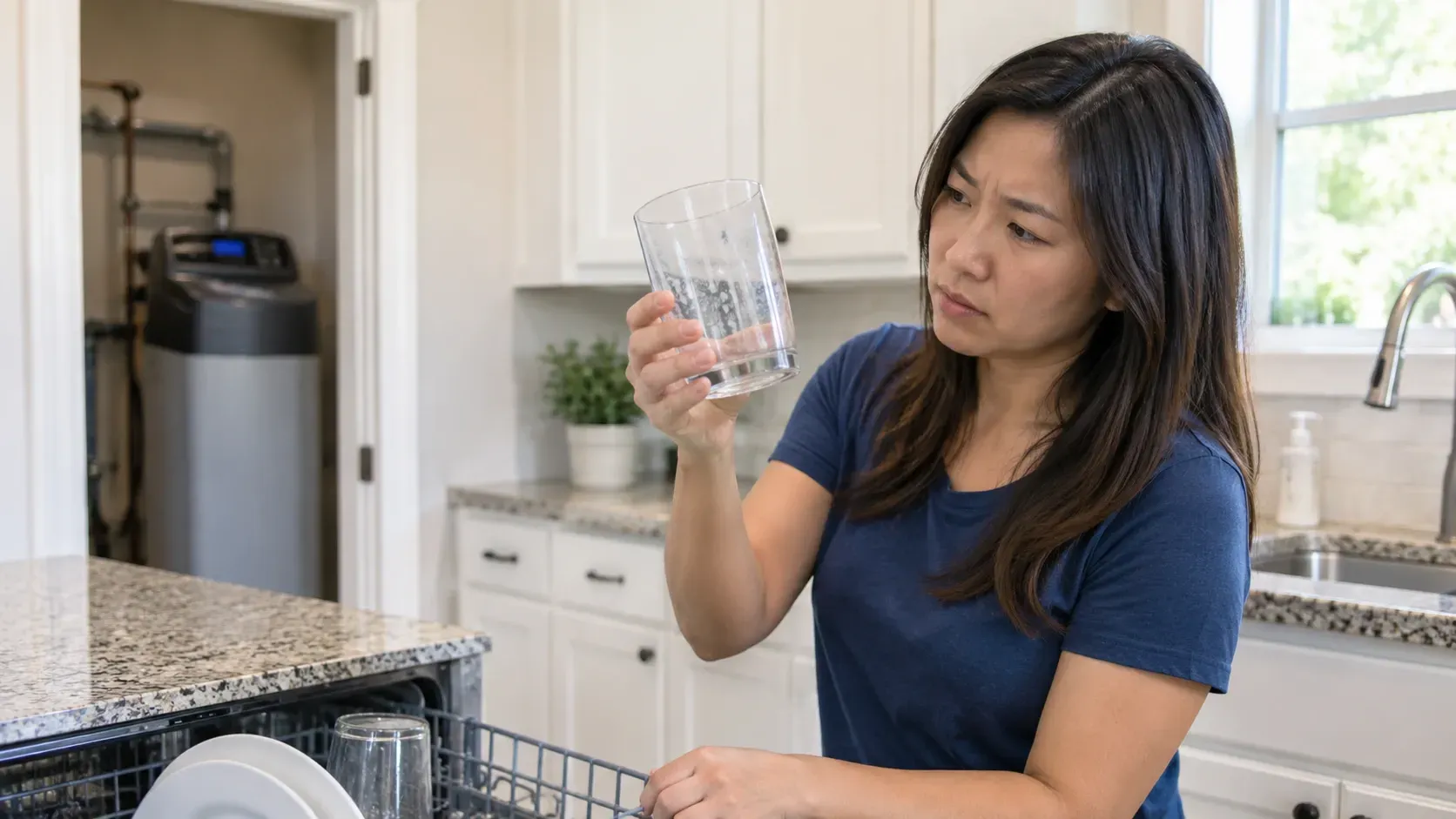
Table of Contents
- Introduction
- Why Does Softened Water Feel Slippery?
- What Soap Does in Hard Water Versus Soft
- Is the Slippery Feeling Sodium or Something Else?
- Why Film on Dishes Is a Different Question
- The One Cause of Film That Is Not Normal
- How to Tell Which Water Problem You Have
- Conclusion
- Schedule a Free Water Assessment
- Frequently Asked Questions
Key Takeaways
- Squeaky skin is soap scum. It was never a sign of being clean.
- Nothing was added to make water slippery. Something was removed.
- Soft water needs dramatically less detergent, and most people never adjust.
- Wipeable deposits and permanent cloudiness are different problems.
- Scale returning on the kettle and shower door is the signal to get it checked.
Introduction
That slippery feeling means your softener is doing its job, because softened water has lost the calcium and magnesium that bind with soap to leave the gritty residue hard water is known for, and it is far and away the most common question we hear in the first week after an install, usually a day or two after somebody has finished reading up on salt options.
The film on the dishes, though, is a different question with a different answer. People ask both in the same breath and assume they share a cause. They usually do not.
Why Does Softened Water Feel Slippery?
Because nothing is being left behind on your skin, which is genuinely new if you have lived with hard water.
Hard water carries dissolved calcium and magnesium. Soap molecules grab onto those minerals and form an insoluble precipitate, which is soap scum, the same grey ring you scrub off the bath. In hard water a good share of your soap goes into making that instead of lathering, and what does not rinse away stays on your skin as a thin film.
That film is what makes skin feel squeaky.
Here is the part that surprises people: squeaky was never clean. It was residue. Take the hardness minerals out and the soap stays dissolved, lathers properly and rinses off completely, and what you are left feeling is your own skin with clean water on it and nothing in between.
So the slipperiness is an absence, not a presence. Softened water is not coating you with anything. It has stopped coating you with something.
| Hard water | Softened water | |
|---|---|---|
| What soap does | Binds with calcium and magnesium, precipitates out | Stays dissolved and lathers |
| Lather | Poor, so you reach for more product | Rich, from much less product |
| On skin | Leaves a scum film, feels squeaky | Rinses clean, feels slippery |
| Shower and bath | Scum ring on tile, glass and fixtures | Far less buildup |
| Laundry and dishes | More detergent needed | Considerably less needed |
| Fixtures and kettle | White scale and crust | Little to none |
Look at the last two rows, because they matter for the rest of this article. Softened water needs much less soap, shampoo, laundry detergent and dishwasher detergent than hard water does.
Almost nobody adjusts. People keep filling the dispenser to the line, using the same shampoo dose, running the same laundry cup. For the shower that mostly means wasting money. In a dishwasher it causes an actual problem, and that is where the film comes in.
Is the Slippery Feeling Sodium or Something Else?
It is not sodium you are feeling, though the question behind it is a fair one.
How the exchange works: a softener runs water through a resin bed that holds sodium ions. Calcium and magnesium in the water swap places with the sodium, which is why the water comes out soft, and the unit periodically regenerates with brine to reload the resin. So yes, softened water contains more sodium than the water going in did. That is the mechanism, not a side effect.
But the slipperiness is not that sodium. Dissolved salt does not feel slippery, which anybody who has swum in the sea can confirm. The feeling is the missing soap scum and nothing else.
On the health question, which is the one people are really asking: how much sodium ends up in your water depends on how hard the source water was to begin with, so it varies house to house and is not something a blog post should put a number on. If anyone in the house is on a sodium-restricted diet, that is a conversation with your doctor rather than with us. Worth knowing that potassium chloride can be used in place of sodium chloride as a regenerant, which is covered in the salt comparison post, and it is a reasonable thing to ask about.
Why Film on Dishes Is a Different Question
Now the second half, and it is worth separating properly because the answers diverge.
Slippery skin: settled, that is the softener working. Film on dishes: several possible causes, and they are not all good news.
- Too much detergent. The most common cause by a distance. Dishwasher detergent is dosed for average or hard water, and soft water needs far less. The excess does not rinse away and dries as a film on everything in the rack. The fix costs nothing: cut the dose substantially and run a few loads.
- Etching on glassware. This one matters. Etching is a permanent clouding of the glass surface caused by a combination of very soft water, too much detergent and hot cycles. It is not a deposit, it is damage, and it cannot be reversed, so catching it early is the difference between adjusting your detergent and replacing your glasses.
- Rinse aid settings. Soft water usually needs less, and in some machines none at all. Too much leaves its own residue.
- A dishwasher with a built-in softener still set for hard water, which several European brands have and which nobody remembers to change.
- Hardness getting through, which is the fault case and gets its own section below.
The quickest way to tell these apart is whether the deposit comes off. Wipe it with a damp cloth. A film that wipes away is detergent or mineral. Cloudiness that stays, especially on glass held up to the light, is etching, and no amount of rewashing will touch it.
The One Cause of Film That Is Not Normal
If what you are seeing is mineral, the softener may not be softening any more.
The distinguishing test is vinegar. Mineral deposits dissolve in it. Detergent film mostly does not, and etching definitely does not. If a chalky white deposit clears when you wipe it with vinegar, you are looking at hardness in water that is supposed to be soft.
Things that cause that:
- A salt bridge in the brine tank, where the salt forms a hard crust above the water line so no brine is actually made. The tank looks full. It is doing nothing.
- The unit sitting in bypass, sometimes left there after plumbing work and never switched back.
- A failed regeneration valve or a control head that stopped cycling.
- Resin fouled by iron or degraded by chlorine over the years.
- Settings lost after a power cut, so the regeneration schedule no longer matches the household.
- Simply out of salt, which is the one worth checking before anything else.
The tell is that it will not only be the dishes. When hardness comes back it comes back everywhere: scale returning on the kettle element, spots on the shower door, crust on faucet aerators, and soap that suddenly does not lather the way it has been. If the dishes are the only thing that changed, it is almost certainly detergent. If the whole house changed, get it looked at.
How to Tell Which Water Problem You Have
Six checks, in this order, and the first five are free.
- Does soap still lather easily from a small amount? If yes, the water is still soft and the dish problem is detergent. If you have quietly started using more shampoo again, hardness is back.
- Does the deposit wipe off? If it wipes away, it is a deposit. If the cloudiness stays in the glass, it is etching, which means detergent dose and water temperature, not the softener.
- Does it dissolve in vinegar? Yes means mineral, which points at hardness getting through. No means detergent or etching.
- Is scale coming back anywhere else? Kettle, shower glass, aerators, the base of faucets. House-wide means the softener. Dishes only means the dishwasher.
- Open the brine tank. Is there salt in it, and is the surface crusted into a solid layer you can push a broom handle through? A bridge is common and easy to miss because the tank looks full.
- Cut the dishwasher detergent dose by half or more for two weeks. Free, reversible, and it resolves the single most common version of this complaint.
If checks one, three and four all point the same way, the water needs testing rather than guessing, and an existing system that has stopped performing is worth raising with technical support rather than living with.
Conclusion
Treat the two symptoms as the separate things they are. Slippery skin needs no action at all beyond using less soap than you are used to, and you will adjust to it within a fortnight. Film on dishes deserves a two-week detergent experiment before anything else, because that fixes most of it for nothing. The version worth acting on quickly is scale reappearing around the house, since that means water that should be soft is not, and the longer that runs the more it costs in appliances. The economics of that are the same ones behind the softener cost question in the first place.
Schedule a Free Water Assessment
If the softened water in your house has started behaving differently, we will come and find out why. APEX Smart Home offers a free water assessment, and our systems are assessed, installed and serviced by in-house technicians rather than subcontractors. We have served San Antonio since 2014, we are licensed and insured under License #B04130001, we are family owned, and we hold the BBB Torch Award for Ethics from 2020. We cover San Antonio, Austin, Boerne, Buda, Cibolo, Houston, San Marcos, Schertz, Universal City and Von Ormy. Ask about
whole-home softeners on (210) 301-0032, email contact@getapexsmart.com, or
book an assessment.
Frequently Asked Questions
Why does softened water feel slippery?
Because soap now rinses off completely. Hard water minerals react with soap to leave a film on your skin, which is the squeaky feeling. Remove the minerals and nothing is left behind, so skin feels slippery instead.
Is slippery water a sign my softener is set too high?
No, it is a sign it is working. The feeling comes from the absence of soap scum rather than from excess sodium or over-softening. Most people stop noticing it within a couple of weeks.
Why does my dishwasher leave a white film on soft water?
Usually too much detergent. Soft water needs far less than the dose most people use, and the excess dries onto the dishes. Cut the amount substantially for two weeks before investigating anything else.
What is the difference between film and etching on glasses?
Film wipes off. Etching does not, because it is permanent damage to the glass surface from a mix of very soft water, excess detergent and hot cycles. Reducing detergent prevents it, but it cannot be reversed.
Does softened water add sodium to my water?
Yes. The exchange swaps calcium and magnesium for sodium, and the amount depends on how hard the incoming water was. If anyone is on a restricted diet, ask your doctor, and ask us about potassium chloride as an alternative.
Related Posts